
About Me
I am currently an algorithm engineer at Alibaba Cloud Intelligence, where my work spans three core areas: Multimodal LLM post-training, Agent Reasoning & Harness, and Efficient Inference. I received my Master’s and Bachelor’s degrees from the School of Computer Science and Engineering, Sun Yat-sen University (SYSU). My research interests include mllm post-training (e.g. RL, OPD), multi-agent harness and data synthesis, and the broader goal of building more capable and efficient multimodal large language models.
🔥 News
- [2026.11] 🎉 Two papers submitted to CVPR 2027
- [2026.09] 🎉 One paper accepted to EMNLP 2026
- [2026.05] 🎉 Three papers accepted to ICML 2026
- [2026.04] One paper accepted by ACL 2026 Findings
- [2025.08] One paper accepted by TOG (Proceedings of SIGGRAPH Asia 2025)
- [2024.06] I joined Alibaba Cloud Intelligence as an algorithm engineer
- [2023.05] I joined Alibaba Cloud Intelligence as an algorithm intern
- [2023.05] One paper accepted by International Journal of Computer Vision (IJCV)
- [2023.05] One paper accepted by TOG (Proceedings of SIGGRAPH 2023)
- [2023.03] One paper accepted by Computer Graphics Forum
📄 Publications
♣ First Student Author

Abstract
Recent advances in online reinforcement learning (RL) for large language models (LLMs) have demonstrated promising performance in complex reasoning tasks. However, they often exhibit an imbalanced exploration-exploitation trade-off, resulting in unstable optimization and sub-optimal performance. We introduce IB-Score, a novel metric grounded in Information Bottleneck theory that evaluates policy’s exploration-exploitation balance by quantifying the trade-off between step-level reasoning diversity and mutual information shared with the correct answer. Analysis based on IB-Score shows that popular online RL approaches (e.g., GRPO) with common regularizers fail to consistently maintain balance during training with suboptimal results. To address this, we propose Information Bottleneck-driven Tree-based Policy Optimization (IB-TPO), a principled framework that formulates IB-Score as a fine-grained optimization objective and utilizes a novel IB-guided tree sampling strategy that not only improves the efficiency of online sampling with 50% more trajectories under the same token budget, but also reuses the tree structure for effective IB-Score Monte Carlo estimation. Extensive experiments across standard benchmarks show that our method significantly outperforms GRPO baseline by 2.9% to 3.6% and also outperforms other state-of-the-art online RL approaches.
Abstract
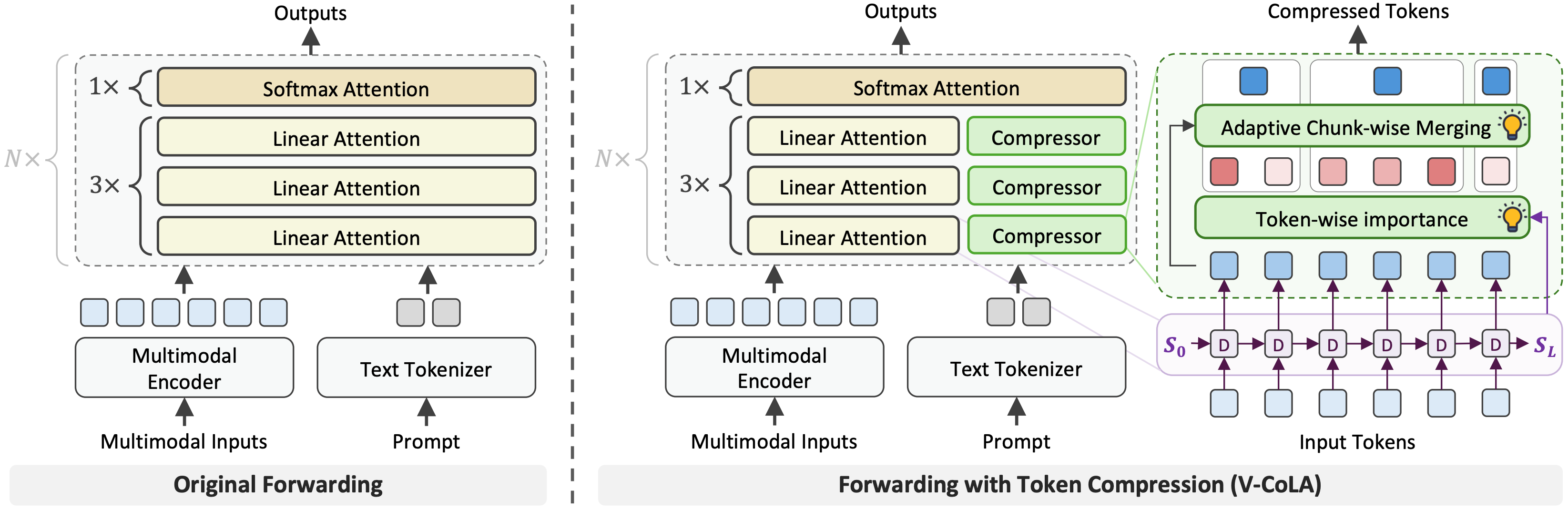
Vision-language models (VLMs) have demonstrated impressive capabilities but suffer from substantial computational overhead, as vision tokens dominate the input sequence. This motivates vision token compression as a key direction to alleviate the burden. However, with the emergence of hybrid architectures incorporating linear attention (e.g., Qwen3.5), prior methods designed for softmax attention struggle to generalize. Our analysis reveals that both attention- and similarity-based approaches suffer notable performance degradation, underscoring the urgent need for compression methods tailored to this regime. To this end, we propose V-CoLA, an efficient training-free token compression framework specifically designed for linear attention. V-CoLA introduces a novel uniqueness-aware importance criterion for identifying critical vision tokens, coupled with an adaptive token merging strategy that performs compression. All components are optimized at the implementation level to remain compatible with the chunk-wise parallelism of linear attention, ensuring strong practical value. Extensive experiments across multiple benchmarks demonstrate the superiority of V-CoLA: it achieves 99.5% of the original performance with only 50.0% of vision tokens, and over 88.0% with as few as 12.5%, while delivering a 1.86x to 6.15x prefill speedup.

Abstract
While GUI agents have advanced rapidly, they often lack the robustness to recover from their own errors, hindering real-world deployment. To bridge this gap at both the evaluation and data levels, we introduce GUI-RobustEval and propose Robustness-driven Trajectory Synthesis. GUI-RobustEval contains 1,216 executable test cases that systematically measure error recovery capabilities across a broad and realistic spectrum of error modes. At the data level, RoTS is a scalable synthesis framework that creates 800k high-quality data via a tree-based pipeline that proactively discovers diverse error modes and synthesizes corresponding recovery steps. Our two models, RoTS-7B and RoTS-32B, fine-tuned on our dataset, both demonstrate significant gains on GUI-RobustEval and traditional GUI benchmarks. Notably, RoTS-32B achieves state-of-the-art performance on OSWorld, with a 47.4% success rate and a 33.8% All-Pass@4 score, suggesting that improved long-horizon error recovery ability contributes to both robustness and overall performance.

Abstract
Effective tool use and reasoning are essential capabilities for large reasoning models (LRMs) to address complex real-world problems. Through empirical analysis, we identify that current LRMs lack the capability of sub-task decomposition in complex tool use scenarios, leading to Lazy Reasoning. To address this, we propose a two-stage training framework D-CORE (Decomposing tasks and Composing Reasoning processes) that first incentivize the LRMs’ task decomposition reasoning capability via self-distillation, followed by diversity-aware reinforcement learning (RL) to restore LRMs’ reflective reasoning capability. D-CORE achieves robust tool-use improvements across diverse benchmarks and model scales. Experiments on BFCLv3 demonstrate superiority of our method: D-CORE-8B reaches 77.7% accuracy, surpassing the best-performing 8B model by 5.7%. Meanwhile, D-CORE-14B establishes a new state-of-the-art at 79.3%, outperforming 70B models despite being 5x smaller.

Abstract
Tool calling requires Large Language Models (LLMs) to generate structured decisions including tool names and schema-constrained arguments, where small decoding mistakes can cause hard failures. Existing methods either rely on costly tool-use training data or only constrain syntax, leaving tool selection and argument value errors largely unsolved. We analyze tool calling failures through a Where-When lens: (Where) failures correlate with persistent uncertainty in late transformer layers, (When) uncertainty concentrates on content-bearing tokens (tool names and argument values) rather than schema tokens. Based on this, and motivated by evidence that transformer Feed Forward Networks (FFNs) act as key-value style memories that store and retrieve factual or associative mappings, we propose Memory Space Tool Retracing (MemTR), a weight-free decoding-time method that retrieves relevant tool evidence from the tool library and mixes it into the FFN-output at the uncertain layer, treating FFNs as key-value memories. Through extensive experiments on various model families (Qwen, Llama, and xLAM) and benchmarks (BFCL, ACEBench, APIBank), MemTR reduces tool calling failures by 2%-9% with only 1%-2% runtime overhead, without any fine-tuning or additional tool-use training data.

Abstract
Decomposing an image I into the combination of structure S and texture T components is an important problem in computational photography and image analysis. Traditional solutions are basically non-learning based, because it is difficult to construct datasets containing ground-truth decompositions or find effective structure/texture supervisions. In this article, we present a self-supervised framework for smoothing out textures while maintaining the image structures. At the core of our method is a texture-inversion observation — if structure S and texture T are well disentangled, then S-T will produce a texture-inverted image that is symmetric to the input image I=S+T and the two will be visually highly similar, while for other conditions that structure and texture are not effectively separated, the generated texture-inverted images will be less similar to the input. Based on the observation, we propose to learn texture filtering from unlabeled data by encouraging the texture inverted image generated from the filtering output to be visually more similar to the input via contrastive learning. Experiments show that our method can robustly produce high-quality texture smoothing results, and also enables various applications.

Abstract
Recent learning-based shadow removal methods have achieved remarkable performance. However, they basically require massive paired shadow and shadow-free images for model training, which limits their generalization capability since these data are often cumbersome to obtain and lack of diversity. To address the problem, we present Self-ShadowGAN, a novel adversarial framework that is able to learn to remove shadows in an image by training solely on the image itself, using the shadow mask as the only supervision. Our approach is built upon the concept of histogram matching, by constraining the deshadowed regions produced by a shadow relighting network share similar histograms to the original shadow-free regions via a histogram-based discriminator. In order to speed up the single image training, we define the shadow relighting network to be lightweight multi-layer perceptions (MLPs) that estimate spatially-varying shadow relighting coefficients, where the parameters of the MLPs are predicted from a low-resolution input by a fast convolutional network and then upsampled back to the original full-resolution. Experimental results show that our method performs favorably against the state-of-the-art shadow removal methods, and is effective to process previously challenging shadow images.

Abstract
We present a simple but effective technique to smooth out textures while preserving the prominent structures. Our method is built upon a key observation — the coarsest level in a Gaussian pyramid often naturally eliminates textures and summarizes the main image structures. This inspires our central idea for texture filtering, which is to progressively upsample the very low-resolution coarsest Gaussian pyramid level to a full-resolution texture smoothing result with well-preserved structures, under the guidance of each fine-scale Gaussian pyramid level and its associated Laplacian pyramid level. We show that our approach is effective to separate structure from texture of different scales, local contrasts, and forms, without degrading structures or introducing visual artifacts. We also demonstrate the applicability of our method on various applications including detail enhancement, image abstraction, HDR tone mapping, inverse halftoning, and LDR image enhancement.

Abstract
Recent methods on image denoising have achieved remarkable progress, benefiting mostly from supervised learning on massive noisy/clean image pairs and unsupervised learning on external noisy images. However, due to the domain gap between the training and testing images, these methods typically have limited applicability on unseen images. Although several attempts have been made to avoid the domain gap issue by learning denoising from single noisy image itself, they are less effective in handling real-world noise because of assuming the noise corruptions are independent and zero mean. In this paper, we go step further beyond prior work by presenting a novel unsupervised image denoising framework trained from single noisy image without making any explicit assumptions on the noise statistics. Our approach is built upon the deep image prior (DIP), which enables diverse image restoration tasks. However, as is, the denoising performance of DIP will significantly deteriorate on nonzero-mean noise and is sensitive to the number of iterations. To overcome this problem, we propose to utilize multi-scale deep image prior by imposing DIP across different image scales under the constraint of a scale consistency. Experiments on synthetic and real datasets demonstrate that our method performs favorably against the state-of-the-art methods for image denoising.